
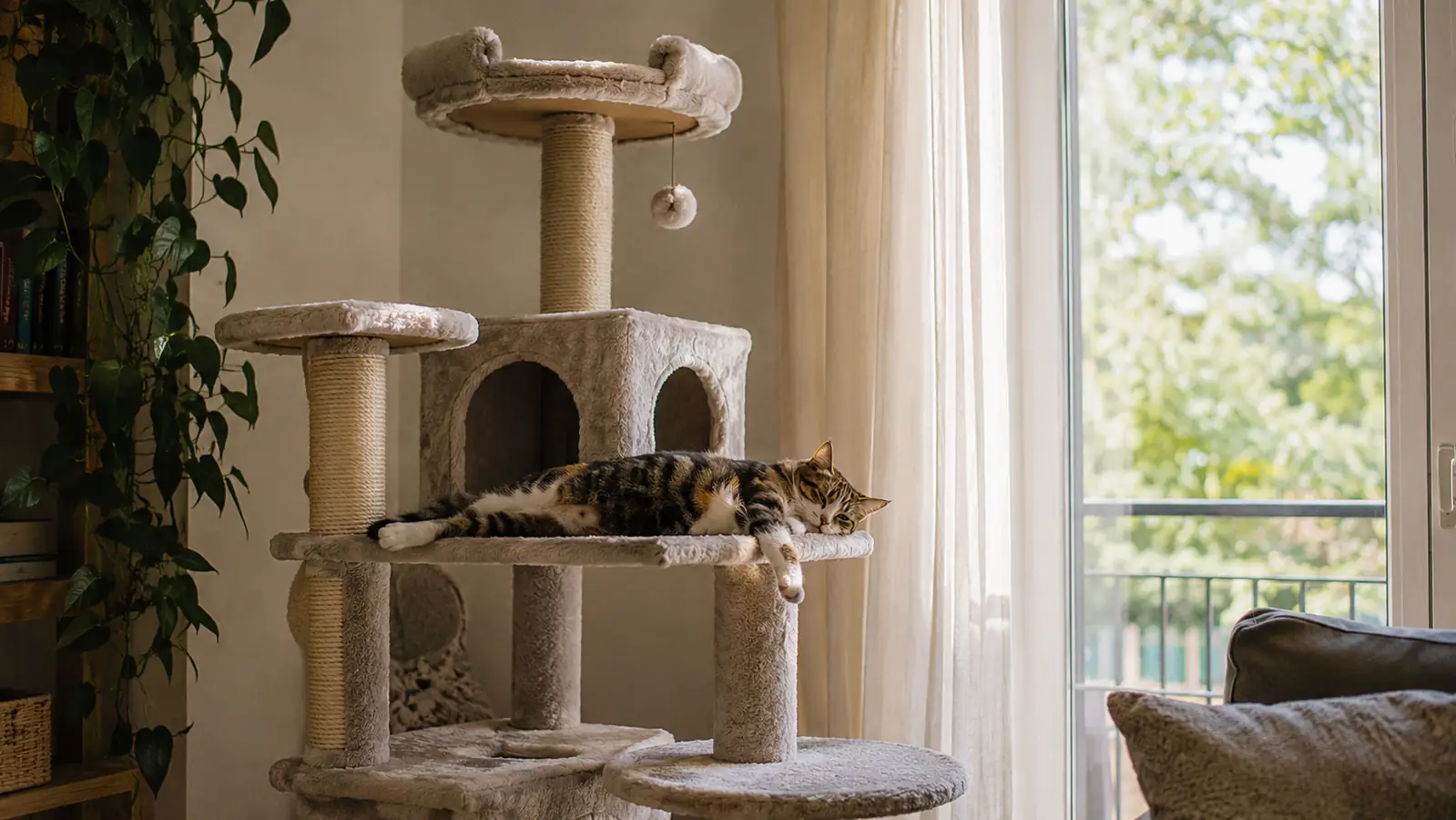
If you live with an indoor cat, you already know the endless negotiation over furniture. The couch is a throne, the bookshelf is a mountain range, and your good chair is prime real estate whether you are sitting in it or not. Every cat wants height, and every cat wants something to scratch, and when neither is available the cat will help itself to the corner of the sofa. I have been there enough times that I stopped getting mad and started looking for a better answer.
Our answer has been the Yaheetech 63-inch cat tree, and it has been sitting in the corner of the living room for six months now. That may not sound like a long time, but it is long enough to catch the wobble in a cheap tower, the sag in a flimsy perch, and every trick a determined cat uses to test whether a piece of furniture will hold her weight. With two large cats in the house, one of them pushing eighteen pounds, stability was the whole question. So here is what half a year of daily use actually taught me.
The Quick Verdict
For big or multiple cats, this is one of the steadiest towers I have used at its size, and six months in it still stands rock solid. It is not perfect, but it does the job the furniture damage was doing for me, and it does it well.
Amazon Check Today's Price →A Steady Tower That Stood Up to an 18-Pound Cat
If you have a big cat, or more than one cat, and you are tired of replacing wobbly towers, this Yaheetech tree is the one I would start with. It held up to real daily use in my house, and the cats use it every single day.
Amazon Check Today's Price on Amazon →How I've Used It
I set the tree up in mid-winter, against the wall in the corner of the living room, on a level part of the floor about two feet from the window. My reasoning was simple: cats want a perch with a view and a warm spot, and that corner gives them both the window and a clear line across the whole room. I figured if I put it where they already wanted to be, they would actually use it. That turned out to be the smartest thing I did with this tree, and it matters more than any feature on the product.
The two residents are Butters, a nine-year-old tabby who weighs about eleven pounds and has opinions about everything, and Smudge, a three-year-old tuxedo who crossed eighteen pounds by his second birthday and keeps going. Smudge is really the test here. He does not cautiously inspect a new perch, he launches himself onto it from two feet away and trusts it to catch him. If a tower is going to wobble, tip, or shed its platforms, Smudge will find it within a week. Six months in, this one has not given him a single chance to prove me wrong.
I want to be clear about the difference between a cat tree that is merely assembled and one that is actually stable. This one uses a wide base and thick posts, and when you tighten the hardware it stays tight. That matters because a big cat does not climb gently. Smudge hits the bottom platform at full speed, springs to the middle, and lands hard on the top perch. A lesser tower would rock with every landing. This one barely moves, and after the first month I stopped checking to see if it had loosened up. It simply has not.
What the Tower Actually Gives Your Cats
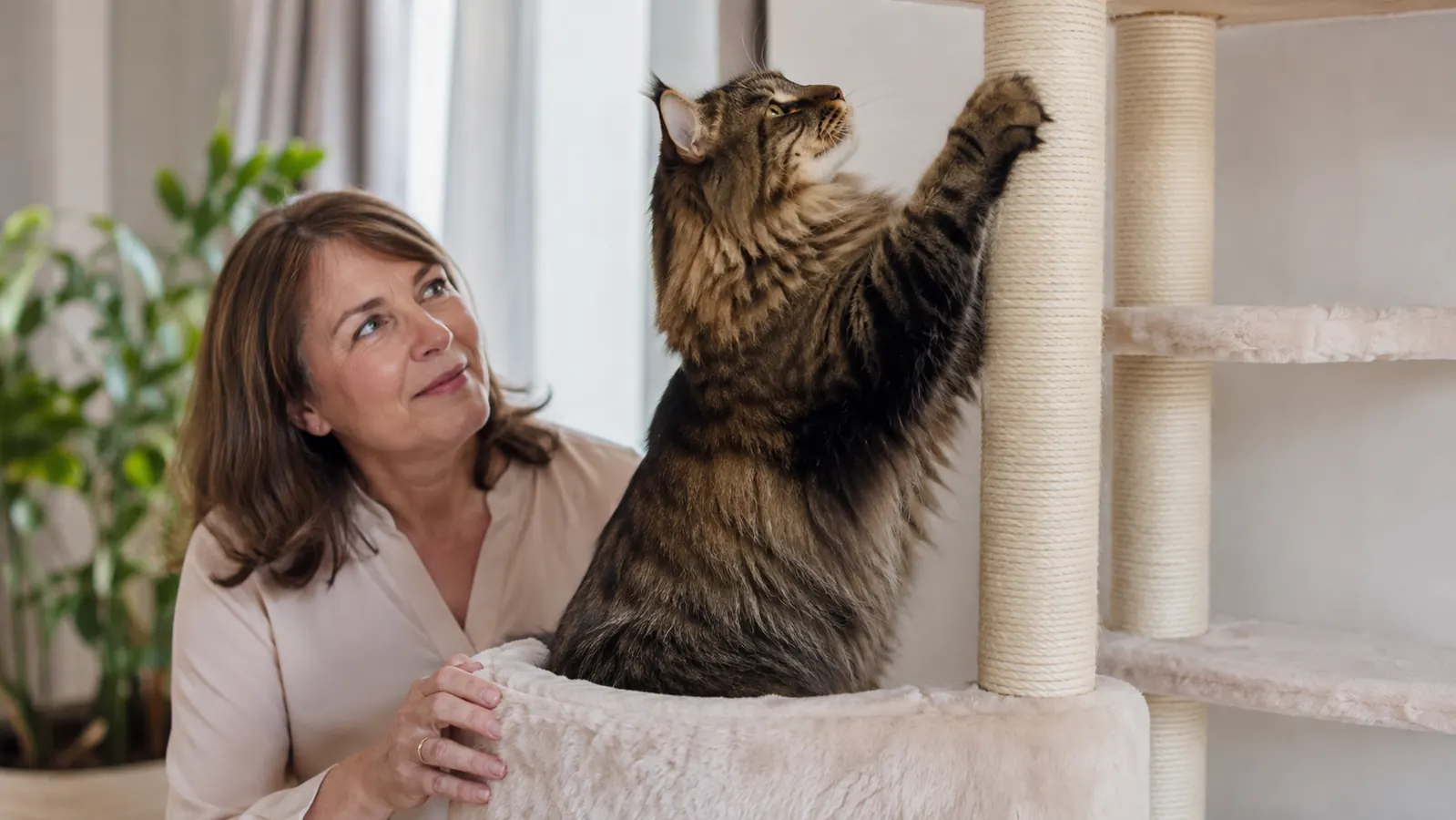
The reason a cat tree works, and why it is not just a fancy scratching post, is that it answers three things your cat is wired to want. Height, so she can watch the room from a place nothing can sneak up on her. A place to scratch that is yours and not the couch. And a fully enclosed or sheltered spot where she can nap without feeling exposed. This Yaheetech tower covers all three, which is why both of my cats use it rather than ignoring it.
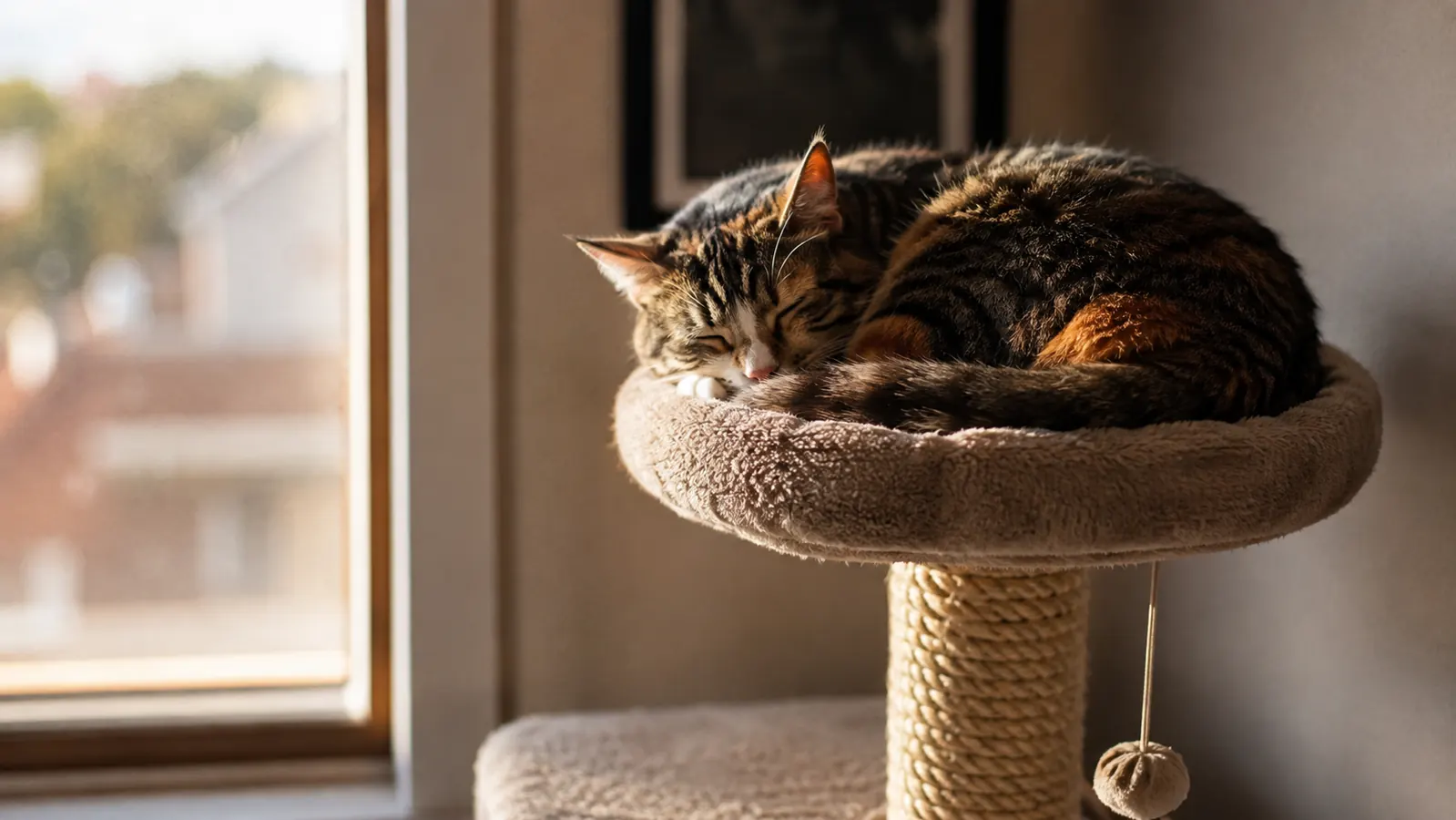
The top perch is where they fight over the view. It sits up high enough that Smudge can watch birds through the window and track me moving around the house, and he treats it like a front-row seat. The middle platforms get used when the top is taken, which tells me the spacing between levels is right for cats that are not especially small. A tree with too much space between levels is a pain for a cat to climb, and one with too little is boring. The step spacing here hits a happy middle, and a heavier cat like Smudge can move between levels without getting stuck or having to jump farther than he is comfortable with.
The hiding spot is the piece I did not expect to matter, and it turned out to be the most used part of the whole thing. Butters is a cat who likes to be near the action but not in it, and the enclosed condo gives him a place to nap where Smudge is not going to charge at him. On quiet afternoons that is where you will find him, curled up and half hidden. For a two-cat household, that little refuge is worth a lot. It is the difference between two cats who tolerate each other and two cats who have somewhere to go when they need a break.
The stability was the whole point for me, and six months in this tower has not so much as wobbled under an eighteen-pound cat launching himself onto it.
Assembly: The Honest Part People Skip
I will be straight with you. This is not a five-minute assembly, and anyone who tells you otherwise is selling something. It arrived in a box of parts that needed to be bolted together, and I set aside a good chunk of an evening for it. There is no way around the fact that a sturdy tower comes in pieces, because a tower that ships fully built would never survive the trip. If you are hoping to unbox it and have it standing in ten minutes, this is not that tower.
That said, the process itself is manageable. The instructions were clear enough that I did not have to guess, which I cannot say for every cat tree I have put together over the years. The tricky part is getting the platforms level and the hardware snug without stripping anything, and that is mostly a matter of patience. My advice is to lay everything out first, read the steps once before you touch a bolt, and not rush the final tightening. Do it right the first time and you will not be re-tightening it a week later, which is exactly the problem that undermines cheaper towers.
One thing worth knowing: do not be surprised if there is a faint new-furniture smell on first assembly. That is normal for this type of product and it faded within a few days of being in a ventilated room. And give it a quick once-over after the first couple of weeks to make sure nothing worked loose during the early, excited usage. Once the initial break-in is over, it settled into a set-and-forget piece of furniture, which is really what you want from something that lives in your living room.
Does It Actually Stop the Scratching?
The honest answer is yes, but with a condition. A cat tree only stops furniture damage if the cat uses it, and a cat only uses a tree you put where she already wants to scratch or perch. I placed mine near the window, which is where the cats naturally wanted to be, and they took to it quickly. The sisal-wrapped posts are what they actually dig their claws into, and the towers do get genuine daily use. But I would not promise that a tree alone will save a couch you leave right in the cat's preferred scratching spot. You still have to meet the cat halfway.
Here is what six months of watching two cats scratch has shown me. The cats do not scratch because they are being difficult. They scratch to mark territory, to stretch, and to keep their claws in shape, and if a good scratching surface is available where they want to be, most cats will use it. The sisal posts on this tower give them that surface, and the placement next to their favorite window gave them a reason to choose it. The result is that the damage that used to be aimed at my couch got redirected here, which was the entire goal.
What I Liked
- Genuinely stable on a wide base, even under an eighteen-pound cat landing hard on the top perch
- Good height with a top perch cats actually fight over for the view
- Enclosed condo gives a multi-cat household a quiet refuge
- Sisal posts see real daily scratching use and redirect it from the furniture
- Clear instructions and straightforward, no-guessing assembly
Where It Falls Short
- Assembly takes a full evening; it is not quick to set up
- Faint new-furniture smell on first setup that needs a few days to air out
- On the taller side, so you want a reasonably high ceiling and a wall to sit against
- Not the right fit for a very small apartment where it would eat the room
The Tradeoffs I'd Flag
For everything this tower does well, it is worth being honest about what it asks of you in return. It is a big piece of furniture, and it needs a wall, some floor space, and a ceiling tall enough that the top perch sits where a cat can actually use it. In our corner of the living room it is perfect. If you live in a small apartment with low ceilings and tight corners, the size might be more than you want, and you would be better served by something smaller. This is a tower for people who have the room and want the cats to have real vertical space.
The other tradeoff is the tradeoff that comes with every good cat tree, which is simply the commitment of setting it up properly. The stability I keep coming back to is not free. It comes from assembling it carefully, placing it on level ground, and giving it a snug final tightening. Skip those steps and you might get a tower that wobbles, and then you would be writing a very different review. I want to be clear that mine has not wobbled, but that result is partly because I set it up right, and the credit goes to the design holding up its end over the months since.
How It Holds Up Over Six Months
The honest test of any cat tree is not the first week, when everything smells new and the cats are curious. It is month three and month five, when the novelty has worn off and you find out whether the cats still use it and whether the furniture still looks the way it did the day you set it up. I am happy to report that six months in, the tower is still in daily rotation and it still looks like a piece of furniture instead of a piece of clip-together plastic that has started to sag.
The sisal posts are the part I expected to show the most wear, since they take the claws every day, and while they are clearly not brand new anymore, they are a long way from shredded. There is no peeling, no posts leaning to one side, and no platforms that have started to tilt under Smudge's weight. I tightened the hardware once, maybe two weeks after setup, and I have not had to touch it since. That is the durability I was hoping for, and it is the reason I would say this tower earns the money compared to the cheaper ones that start going floppy by month two.
The cats have never stopped using it either, which is the other half of the story. Butters still claims the condo on quiet afternoons, and Smudge still treats the top perch like it belongs to him. A tree that gets ignored after the first month is a wasted purchase, no matter how stable it is, and the fact that both cats use theirs every single day is the real proof that this one earned its corner of the room.
Who This Is For
This tree is for the owner of big cats, or multiple cats, who is tired of replacing towers that tip over the moment the fun starts. If you have a cat like Smudge who launches himself onto furniture and trusts it to hold, you want a tower with a wide base and thick posts, and this is that tower. It is also for anyone with an indoor cat who needs a high perch and a sheltered napping spot, because it gives a cat a real home base that keeps her off the top of your bookcase. And it is for the multi-cat household that needs a place where the shyer cat can get away, which the enclosed condo handles beautifully.
Who Should Skip It
If you are short on floor space, this is probably more tower than you need, and a smaller model would serve you better without eating your whole room. The same goes for anyone with low ceilings, since the height is half the point and it needs somewhere to go. And if the idea of spending an evening on assembly sounds like the last thing you want to do with your weekend, you should know going in that this is not a ten-minute setup. For those situations a simpler, shorter tree is the more honest recommendation.
Give Your Big Cats Somewhere Steady to Land
After six months with two heavy cats using it every day, this Yaheetech tower is the one I would buy again with my own money. If you have the space for it, it will earn its corner.
Amazon Check Today's Price on Amazon →